
Review of Ten Years of IP Filing Activity in Berlin
Following our detailed analysis of patent and utility model applications in Berlin for the year 2023, we now take a look at the longer-term development. As usual, the basis is the publicly available data of the German Patent and Trade Mark Office (DPMA) on German patents and utility models with applicants based in Berlin.
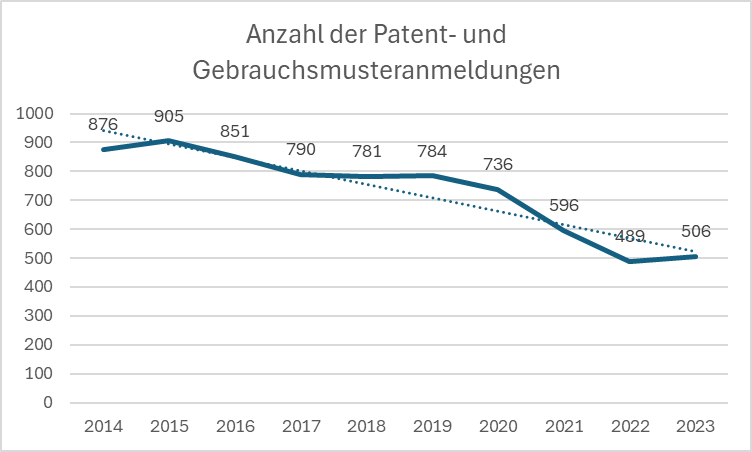
The chart shows the annual number of new applications in the period from 2014 to 2023. In the mid-2010s, Berlin was at a very high level:
In 2014, 876 applications were recorded, in 2015 a local peak was reached with 905 applications, and in 2016 there were still 851 IP rights.
From 2017 onwards, a moderate decline can be observed. The number of new applications initially ranges between 790 (2017) and 784 (2019). In 2020 – the first pandemic year – the figure falls further to 736 applications.
Clear Dip During the Pandemic – and Initial Recovery
The slump in 2021 and 2022 is particularly striking:
In 2021, 596 patent and utility model applications were filed in Berlin, and in 2022 only 489. The number of applications was therefore well below the already weakened level of the previous years.
For 2023, there are signs of a slight trend reversal. With 506 applications, Berlin again records an increase of around 3.5% compared with 2022. Although the peak levels of the mid-2010s are still some way off, the development shows that innovation activity is picking up again after the pandemic-related setbacks.
Possible Reasons for the Decline
The figures cannot be attributed to a single cause, but they do provide indications of structural changes:
- Economic and pandemic-related effects: In times of economic uncertainty, development projects are often postponed or stretched – with a direct impact on the number of IP right filings.
- Shift in filing strategies: Companies are increasingly relying on European or international (PCT) applications. National German applications remain important but do not always reflect the entire IP portfolio.
- Sector-specific shifts: Berlin’s economy is strongly shaped by service industries, IT and creative sectors. Innovations in these areas are in part protected more through trade marks and designs or copyright structures than through classic technical IP rights.
It is therefore important to note that the number of German patent and utility model applications reflects only a segment of the actual level of innovation.
Putting the Berlin Figures into Context
As explained in our article on the Berlin filings in 2023, the figures we have determined differ from the total numbers reported in the DPMA annual report. The reason is that, in addition to German first filings, the DPMA also counts national PCT phases, which are not included in our analysis. However, these differences do not change the fact that German first filings are a good indicator of innovation and development activity at the location.
Conclusion:
The long-term view shows that Berlin has experienced a noticeable decline in patent and utility model applications over the past ten years, in particular during and after the pandemic. At the same time, the slight recovery in 2023 indicates that innovation dynamics are returning.
For companies and individual inventors, it remains crucial to protect their technical innovations strategically – especially in a competitive environment in which development resources are being focused more selectively.
As patent attorneys based in Berlin, we are happy to support you in developing the right IP strategy for your innovations – from the initial idea and the national filing through to European and international procedures.