
With this article, we continue our annual review of filing figures from Velbert (click here for the article on the 2023 filing year). Who filed IP rights in 2024 – and how does the year fit into the long-term trend?
As already explained in last year's article, patent applications are generally not published until 18 months after their filing or priority date. A largely complete picture of the 2024 filing year can therefore only be drawn now. The research was conducted as of 28 July 2026.
Results for 2024
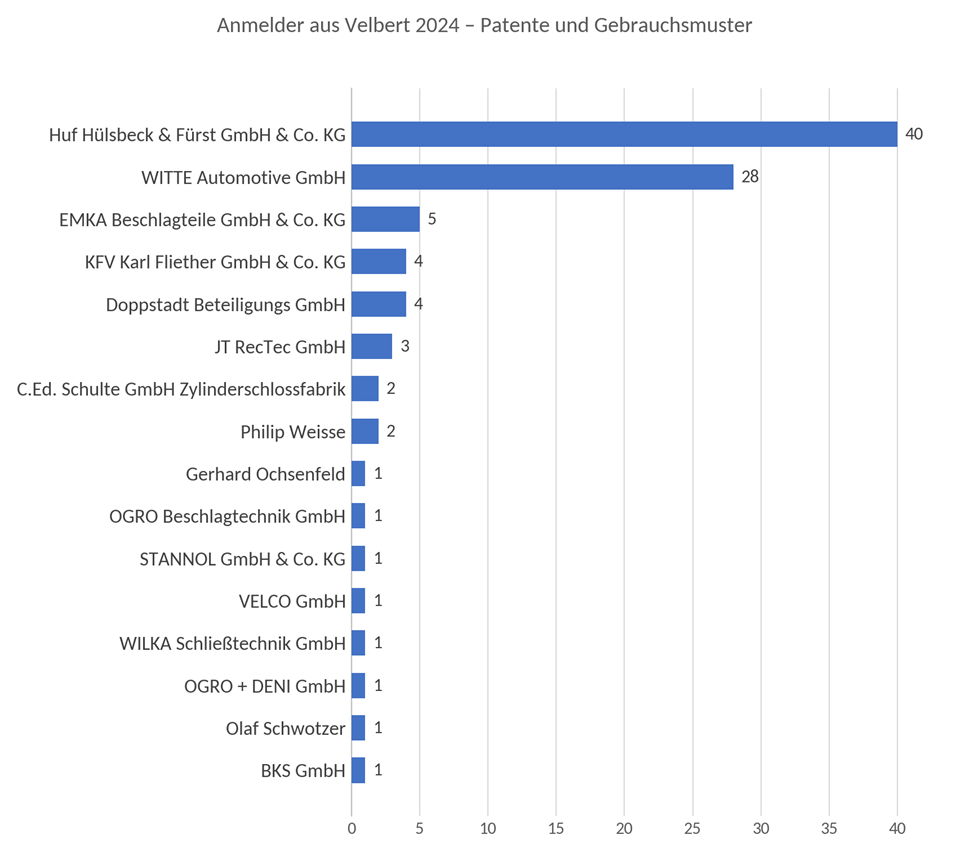
In 2024, a total of 96 German patent and utility model applications were filed with the German Patent and Trade Mark Office (DPMA) by 16 companies and private individuals from Velbert. Of these, 90 were patents and six were utility models. In the previous year, there were 99 applications from 17 applicants.
At the top stand – unsurprisingly – the large automotive suppliers:
– Huf Hülsbeck & Fürst GmbH & Co. KG with 40 applications
– WITTE Automotive GmbH with 28 applications
At a clear distance follow:
– EMKA Beschlagteile GmbH & Co. KG with five applications
– KFV Karl Fliether GmbH & Co. KG with four applications
– Doppstadt Beteiligungs GmbH with four applications
– JT RecTec GmbH with three applications
In addition, there are several smaller companies and individual applicants with one or two IP rights each, including C.Ed. Schulte GmbH Zylinderschlossfabrik (CES), Philip Weisse and WILKA Schließtechnik GmbH. The full distribution across all 16 applicants is shown in the following chart:
It may be that some companies have in parallel also filed a large number of European or international (PCT) applications. Nevertheless, the number of German applications already offers a good indication of the development capability of the companies. In filing practice, a German first application usually takes place first, followed by international PCT or European subsequent applications.
Huf Hülsbeck & Fürst GmbH & Co. KG, for example, filed an additional 33 European and international PCT applications in 2024. EMKA Beschlagteile GmbH & Co. KG filed five and WITTE Automotive GmbH one further application. A large proportion of these filings claim the priority of German applications from 2023.
Development over the past ten years
We last discussed the long-term development in our article “Patents and Utility Models Over Time”. The figures for 2024 continue the trend seen recently.
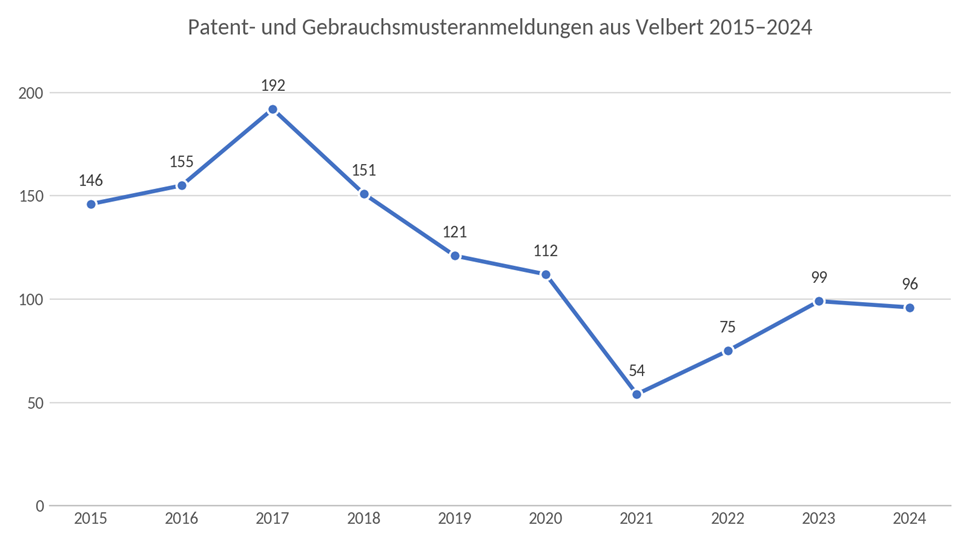
The ten-year comparison reveals two clearly distinct phases: in the mid-2010s, filing numbers from Velbert were at a consistently high level, ranging between 146 applications and the peak of 192 applications in 2017.
This was followed by a gradual decline, which intensified markedly during the pandemic years. With just 54 applications, 2021 marks the low point of the period under review.
Since then, filing activity has recovered noticeably: 75 applications in 2022 were followed by 99 in 2023 and now 96 in 2024. Filing numbers have thus stabilised just below the mark of 100 applications per year. This points to continuous, strategically managed innovation work. However, the level of the pre-pandemic years has not yet been reached again.
Velbert in comparison: well above the national and state average
We already showed for 2023 that, relative to its population, Velbert ranks among Germany's strongest patent locations. Nothing changed in this respect in 2024.
With 90 patent applications and a population of around 82,000, Velbert accounts for roughly 110 patent applications per 100,000 inhabitants. For comparison: according to the DPMA Annual Report 2024, the corresponding figure is 47 nationwide and 29 in North Rhine-Westphalia.
Velbert thus reaches more than twice the national average and almost four times the North Rhine-Westphalian average. Even compared with the strongest federal states, the figure is remarkable: Baden-Württemberg records 137 patent applications per 100,000 inhabitants, Bavaria 85.
For utility models, too, Velbert – at a good seven applications per 100,000 inhabitants – is above the national average of six. North Rhine-Westphalia records a figure of eight here.
Note on the Statistics
Comparability is limited, as the DPMA figures also include PCT applications in the national phase as well as provisional filings, some of which are not published. The actual innovation rate in Velbert is therefore likely even higher.
Conclusion
With 96 patent and utility model applications, 2024 confirms the recovery that has been evident since 2022. After the marked decline down to the low point in 2021, filing numbers have now stabilised again just below the mark of 100 applications per year.
This development is driven above all by Velbert's large industrial companies. At the same time, the participation of smaller companies and individual inventors shows that innovation activity is not limited to a few major applicants. The ten-year comparison thus makes one thing clear: the high filing numbers are not a short-term spike but the expression of an innovation landscape that has grown sustainably – even if the peak level of the years before 2020 has not yet been reached again.