
Following our analysis of Berlin's filing figures for 2023 and our review of the development from 2014 to 2023, we are continuing our IP statistics series and have examined the new filings of patents and utility models in Berlin for 2024. As before, both companies and private individuals were taken into account
A Look at the Intellectual Property Statistics
The data comes from the register of the German Patent and Trade Mark Office (DPMA) and is publicly accessible. Our analysis only takes into account new filings of German patents and utility models. Since patent applications are only published after 18 months, a complete overview is now available for the 2024 filing year.
Results for 2024
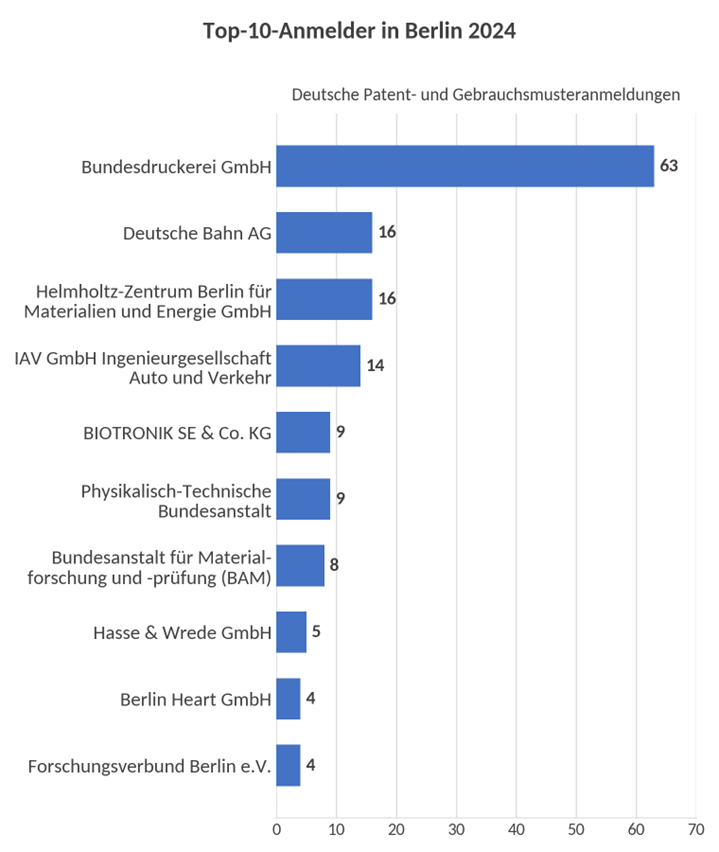
In 2024, a total of 421 German patent and utility model applications were filed with the DPMA by 260 different companies and private individuals from Berlin. Bundesdruckerei GmbH was particularly active with 63 applications – more than twice as many as in the previous year (31). It is followed by Deutsche Bahn AG and Helmholtz-Zentrum Berlin with 16 applications each, and IAV GmbH with 14 applications. Brose Antriebstechnik GmbH & Co. Kommanditgesellschaft, still Berlin's most active applicant in 2023 with 42 applications, no longer appears in the 2024 list.
Development over the last ten years
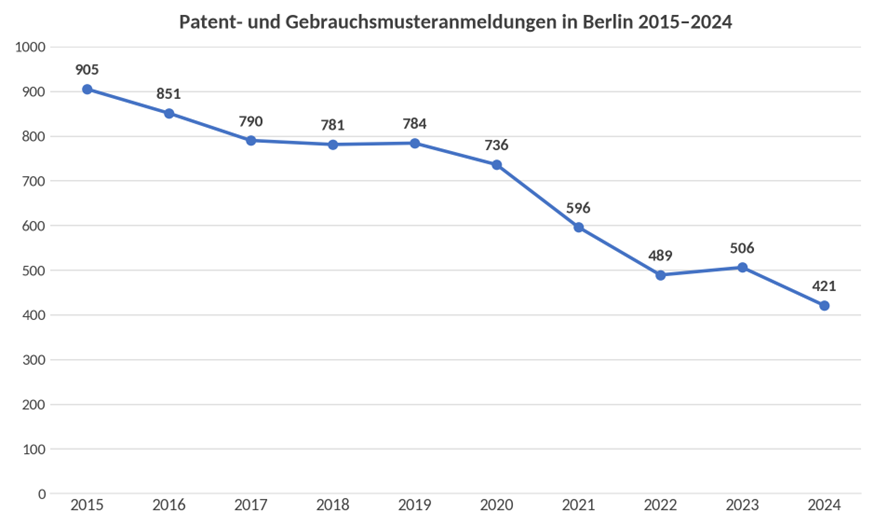
After the slight recovery in 2023 (506 applications), the figures fell again significantly in 2024: with 421 applications, Berlin is around 17% below the previous year's figure and, for the first time, below the previous low from 2022 (489 applications).
Interpreting the Figures
In its official 2024 annual report, the DPMA reports a total of 606 applications for Berlin, comprising 468 patents and 138 utility models. The official count thus also shows a decline in Berlin's filing figures (2023: 675). As explained in more detail in our article on the 2023 filing year, the difference compared to our analysis is mainly due to the fact that the DPMA also counts national phase entries of PCT applications, which we do not include. In addition, there are applications for which no fees are paid and which are therefore never published – they are included in the official statistics but are not visible to us via the register.
Berlin is by no means alone in this development: despite the nationwide increases in 2023 and 2024, domestic patent applications remain well below the level of the 2010s, and the recent growth is almost entirely attributable to Baden-Württemberg and Bavaria.
Additional European and International Filings
Many companies file European or international (PCT) applications in parallel with their German IP rights. Bundesdruckerei GmbH, for example, filed an additional 35 European applications in 2024; Deutsche Bahn AG accounts for two, Helmholtz-Zentrum Berlin for eleven and IAV GmbH for three further European applications. Most of these rights claim the priority of German applications from the previous year – a typical approach for building international protection on a national basis.
Precisely because European and international subsequent filings usually derive their priority from a German first filing, the German filing figures remain a reliable indicator of innovation and development activity in the region.
Conclusion
With 421 applications, Berlin reached its lowest figure of the past ten years in 2024 – the slight recovery of 2023 did not continue.
However, this is not a development unique to Berlin: the nationwide recovery in 2023 and 2024 is driven primarily by the automotive and supplier industry in Baden-Württemberg and Bavaria; most other federal states remain well below their mid-2010s levels, and the city states of Berlin and Hamburg have almost halved over the decade.
Factors that may play a role here are those already described in our review of the years 2014–2023: economic caution regarding development projects, the shift in filing strategies towards European and international procedures, and Berlin's economic structure, in which innovations are more frequently protected by trade mark and design protection than by classic technical IP rights.